Making a decision is simultaneously part of the mundane humdrum of daily life (what to have for dinner?) and a very complex negotiation of the known and the unknowable.
Scotland is abundant in many ways: opinions on the perfect stovie; renewable energy sources; and civil society action. Part of the Living Good Food Nation Lab’s remit is to develop a series of case studies that engage with, document, and showcase the ways that food system transformation is both emerging and actually existing, specifically within civil society, grassroots, and community organisations.
The plethora of potential case studies, combined with time and capacity constraints, makes area selection simultaneously extremely interesting but also extremely difficult. We can’t do intensive deep dives with all the places, people, and organisations we would like to work with, but we need to gather insights that are useful in the development of the first Local Good Food Nation Plans. This means illuminating the nuances of place and commonalities across the country.
Likewise, decisions around research ‘samples’ (that is, the participant group) are not always transparent in terms of who they intend to represent. In media entertainment, you will often see statements affirming the efficacy of a new shampoo or cream with ‘90% of respondents agreeing’ with whatever the marketing claim is. Or, you may read a study commenting about preferences of a whole population, but the researchers have only spoken to a very particular group. In an attempt to remedy such a common opacity, and to be transparent about process, this blog details the framework considerations we have developed as part of our approach to case study area selection.
The Grassroots and Community Unit of the Lab asked (and continues to ask!) a series of questions: what do we already know, and how (establishing our knowledge base)? Where can we find existing work, and can we use it (avoiding replication)? What are the similarities in Scotland, and where are there divergences (thinking of material landscape, policy implementation and population, for example)? Who do we know and where can we build organisational capacity (avoid overloading)?
These (non-exhaustive) considerations will then undergo discussions within the Lab, including our central partners like the Scottish Food Coalition and Nourish to form the basis for decisions about intended case study areas.
However, the Unit, like the broader Lab aims to be flexible and responsive. When the selection has been made, we are still keen to hear from other areas and document learning to be incorporated into outputs and resources from the Lab.
If you would like to discuss any of these criteria, share a systems-changing project, or hear more about our work, please get in touch with me: beth.cloughton@ed.ac.uk
Criteria
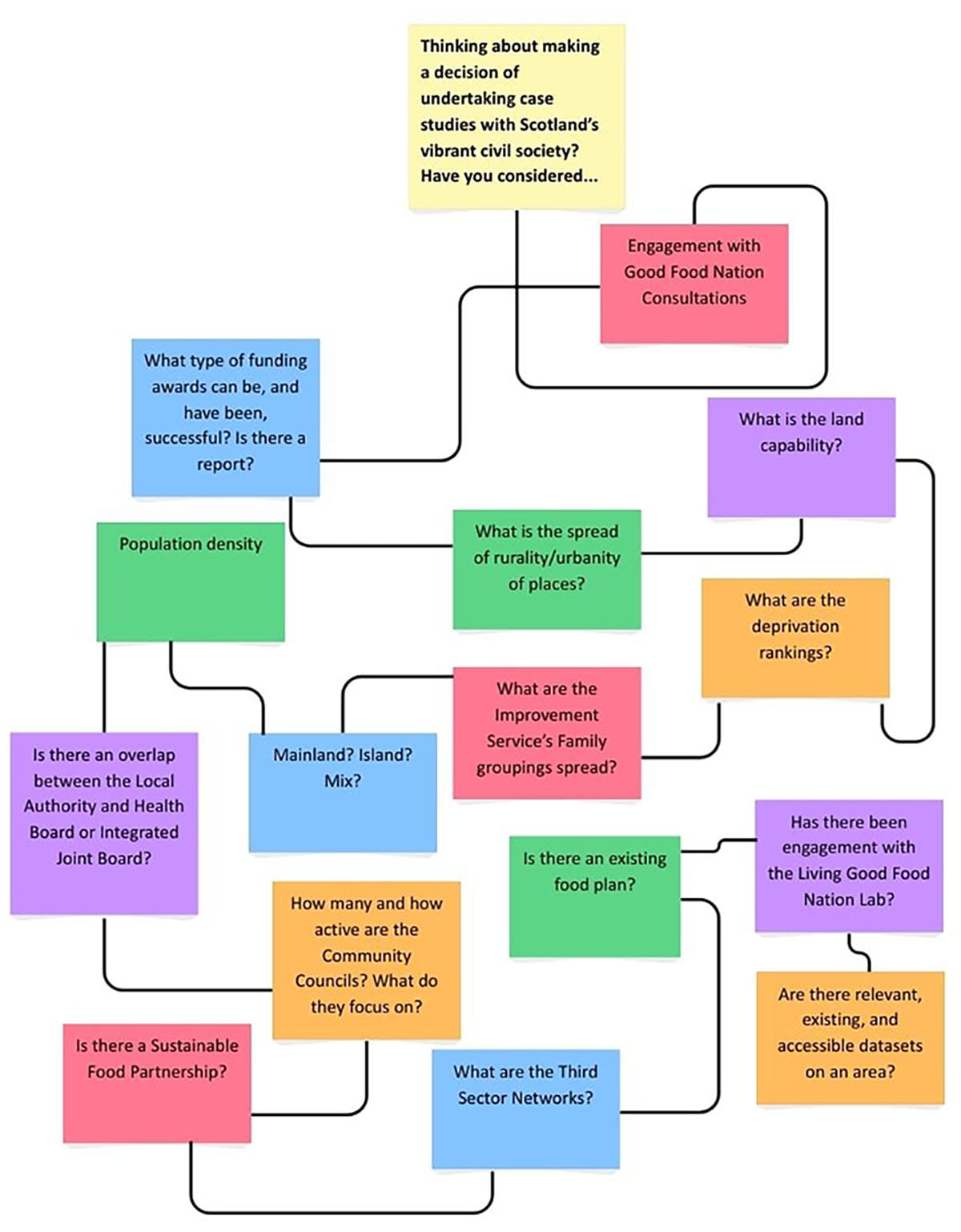
By mapping these questions and answers, we have developed a list of criteria:
- Engagement with Good Food Nation Consultation(s)
- This includes both the presence of responses to consultations, and absence.
- Funding Awards
- Have organisations been successful in different funding bids, and for what purpose?
- Rurality and Urbanity (based on Scottish Government’s index)
- This is a 7-point range enabling different types of land to be indexed.
- Land Capability (based on the Hutton Institute data)
- By asking what ‘type’ of land an area consists of, we can consider agricultural v urban growing; land ownership types; and how land may change.
- Deprivation Ranking
- The rank is updated every four years, but we need to be careful that the types of indicators that are indexed doesn’t hide certain types of poverty.
- Improvement Service (IS) Family Grouping for Children, Social Work and Housing Indicators
- The improvement Service is an organisation supporting Local Government improvement.
- Improvement Service Family Groupings for Environmental, Culture & Leisure, Economic Development, Corporate, Property and Tackling Climate Change indicators
- Both these IS benchmarking indicators are ways that councils can compare ‘like for like’ types of population an area serves.
- Mainland/Island
- Population Density
- Local Authority and Health Board/Integrated Joint Board (IJB) Overlap
- Active Community Councils
- Sustainable Food Places partnership
- Third Sector Networks
- This may include the Third Sector Interface, Voluntary Organisation collectives, and semi-formal networks.
- Existing Food Plans
- Engagement with the Living Good Food Nation Lab
- Existing Research Datasets
- Lots of areas have been researched – we don’t want to replicate good work that has already happened, so which areas have a density of research data we can access?

Beth Cloughton is our Research Fellow in Food Systems Transformation (Grassroots & Community).