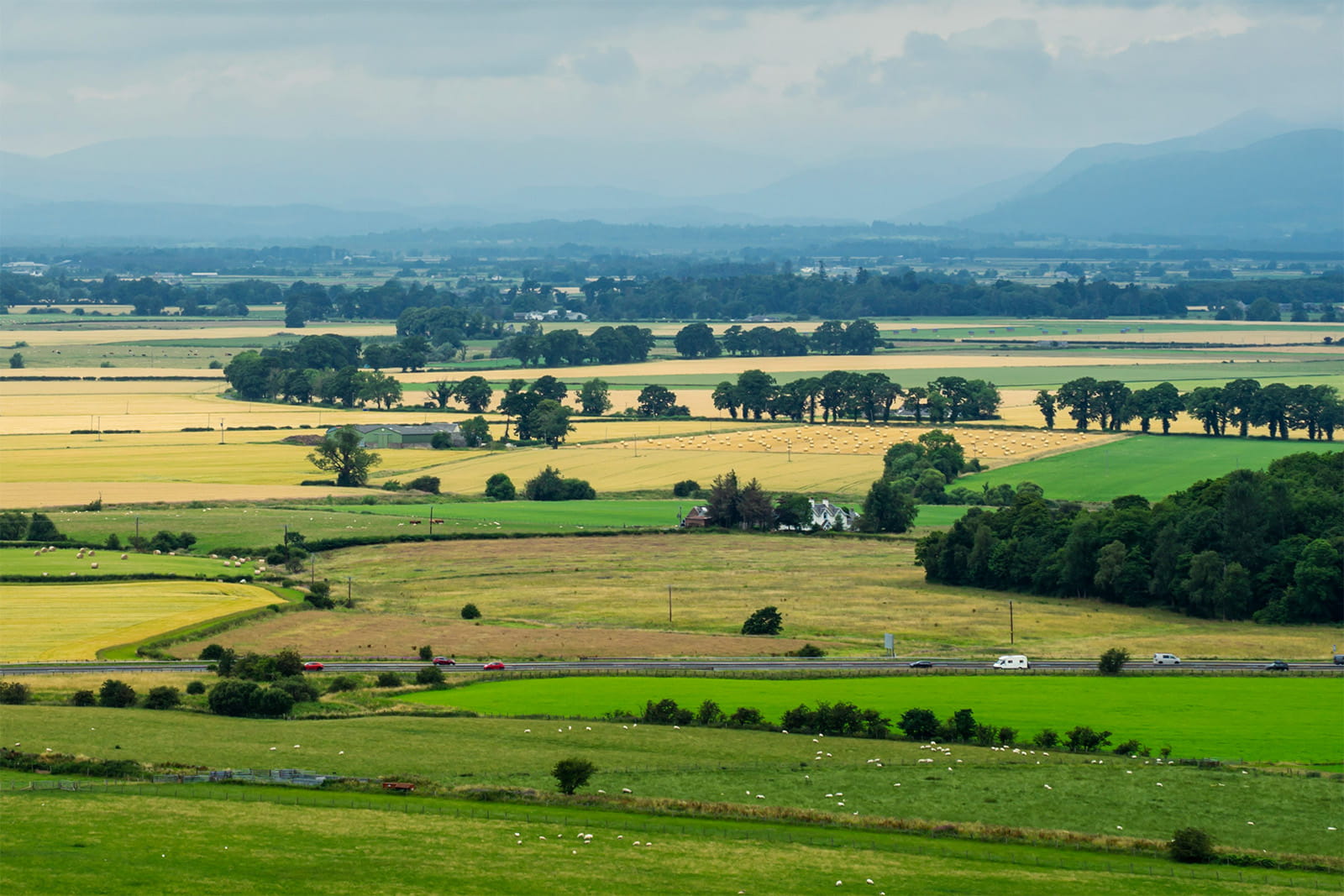
…the violence of the Scottish transition towards capitalism is actually quite unique in the world. Very few countries have experienced transition from a sort of peasant, particularly a kind of lineage, semi-tribal lineage economy to a full-blown capitalist economy in the course of, you know, pretty much a century. It's actually quite unique globally ,.. that has implications for our sense of the food we can produce
Isabelle Darmon, member of the unit, presented key analysis of how land does(n’t) feature in the National Good Food Nation plan, followed by a panel discussion. The panel, chaired by unit member Beth Cloughton, consisted of those with wide and deep knowledge of land in Scotland and beyond, worker rights, legacies of colonialism, government interventions, and community land ownership (a list of speakers is at the end of the document).
Over the course of two hours, we spoke across a range of land-related topics, from the history of dispossession in Scotland, to community action. Below is a very short snippet of key points raised and questions asked.
Key Points
…there are infinite other ways to govern land. And I suppose what the history shows us is the land is capable of much more than we imagine, much more than is demonstrated that on the land capability map.
- Importance of Land: Land is crucial for transforming food systems, impacting local democracy, community relations, and environmental outcomes.
- Historical Context: Scotland's violent transition to land ownership impacted food production and people’s relationship with land. Both historical and contemporary practices showcase(d) more diverse food uses, suggesting the potential for broader agricultural capacity than what currently captures the attention of Scotland’s food system.
- Opportunities: Suggestions to improve land use and relations included public procurement policies, using local authority land for community agriculture, and aligning land reform with food policy.
- Challenges and Solutions: Issues of land access and inequality persist. Solutions proposed involved improving community-local authority collaboration and reframing investment and policy support for local food systems.
Questions Asked
- Why does land matter in food system transformation?
- What can the history of land in Scotland help us think about for the future of our food system?
- Can we hear about the current land policy context? Perhaps about land reform, land market regulation, increasing diverse access?
- What policy, or other opportunities are there for making land more central, more impactful to local GFN plans?
- What opportunities are there for joined up work by relevant authorities together with their community partners to push for reforms at a higher level, and for these to be supportively implemented?
Audience Questions
- How do we reframe food at a community level in terms of security, wellbeing, human rights, and resilience rather than a commodity?
- Can anyone speak to the history of food growing in urban areas?
- I'm curious about the language of efficiency. Tara pointed out rightly that subsidies assist land consolidation, but that could be seen as a good thing with efficiency as a metric, as it is in industrialised agriculture. What language/ideas can challenge/replace this?
- Locally produced food is often seen as more expensive, or less efficient if its not the 'best' crop to grow in a given area (hence leading to the gravitation towards single commodity, and the regionalisation across the UK of certain production types) - how do we move away from the efficiency narrative to diversity and utilisable food conversation? Is local food more resilient? healthier? more accessible?
- When the market is broken and the public sector finances are under strain and slow to evolve, where can a more regenerative form of investment come from?
Panellists
Adam Calo
Adam is Assistant Professor of Environmental Governance and Politics at Radboud University in the Netherlands. He writes the academic newsletter Land Food Nexus and produces the podcast, Landscapes.
Josh Doble
Josh is Director of Policy and Advocacy at Community Land Scotland. Josh's role is to lead on policy advocacy and development to ensure that the benefits of community ownership and further land reform are understood at a national and regional level. He has a background in policy and research, both in government and academia, as well as in the food and drink industry.
Elise Wach
Elise is a Research Fellow at the Institute of Development Studies and a community food grower in Southwest England. Her research focuses on land relations and public infrastructures for universal access to nutritious, ecologically produced food. She currently leads DISHED, a public dining project, with a focus on the possibilities for publicly sourcing local, ecological and ethically produced food.
Kathie Pollard
Kathie is Head of Policy at the Scottish Land Commission, leading the team responsible for policy advice, analysis and research to inform key areas of land policy. Together they provide advice to government, parliament and stakeholders. She has a background working on planning, environmental and nature finance policy working for the Scottish Government and third sector organisations. Since joining the Commission in 2018, Kathie has worked on a wide range of land reform topics including tax, vacant and derelict land and measures to address concentrated landownership.
Fraser Sugden
Fraser is an agrarian political economist based in the School of Geography, Earth and Environmental Sciences at the University of Birmingham. He has written extensively on agrarian political economy in the context of contemporary climatic, agro-ecological, political and economic stresses. His interest in agrarian transition in Scotland is located within a more global outlook (with years of fieldwork in South and East Asia). Fraser is committed to interdisciplinary action research with strong engagement and partnership with civil society and organisations working at the grassroots.
Tara Wight
Tara is the Scotland Policy and Campaigns Coordinator for the Landworkers’ Alliance, where she works on land justice, agroecology and food sovereignty. She has a background in agricultural science research, and now works with farmers, crofters and growers across Scotland to campaign for a fairer and more sustainable food system. Her work focuses on improving access to land, supporting agroecological farming, and shaping policy to enable a just transition in food and agriculture.
Thanks
We are hugely grateful to the panellists for speaking candidly and with care about the topic. Land and food system transformation are intimately tied. If we do not cast a critical view of our current land relations and use, then a Good Food Nation cannot equitably be achieved. To end, we finish with a powerful statement from one of our panellists:
…there has been a kind of imaginative capture by landowners and their representatives, that talking about history is not helpful, is the politics of grievance, is trying to be divisive, trying to get back to some kind of... you know, kind of restorative justice rather than putting forward a positive vision for the future…it's on all of us who care about and understand these issues to tie the history to a positive vision of the future and use that to inform the work that we're doing and say, actually, you know, we can't meaningfully plot the way we want to go until we understand where we've come from.
Watch the webinar: The Question of Land in a Good Food Nation.