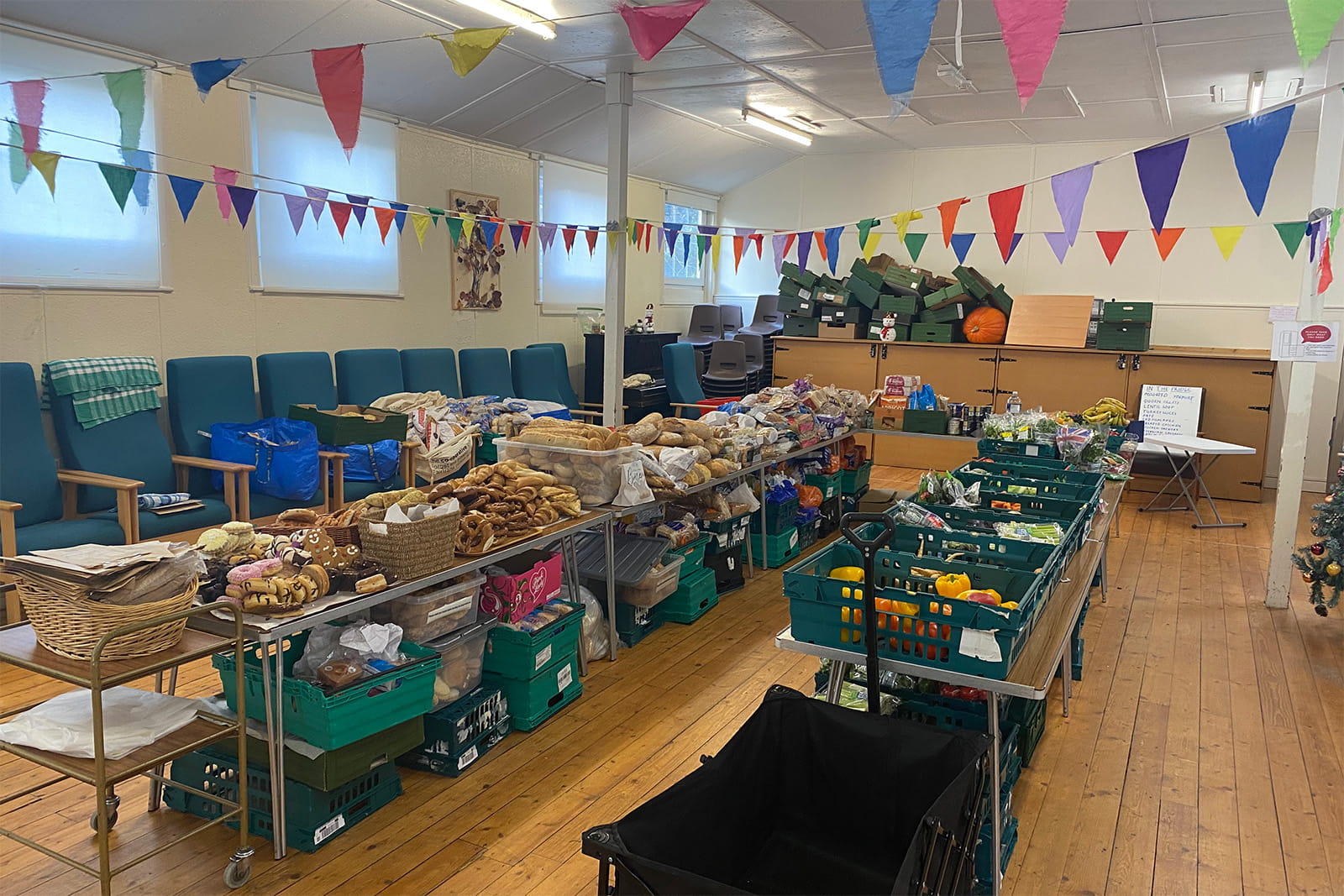
In May 2026, the UK prime minster, Keir Starmer announced plans to significantly expand (triple) food redistribution across the UK, presenting surplus food as part of the solution to both reducing food waste and eliminating food insecurity. On the surface, the logic appears compelling: edible food that would otherwise be wasted is redirected to people who need it. Yet this “win-win” framing conceals a deeper contradiction. Food insecurity and food waste continue to rise side by side, revealing a paradox of scarcity within abundance.
As Pete Ritchie, Executive Director of Nourish Scotland, argues:
Food redistribution is like the famous duck rabbit diagram. Look at it one way it is an environmental issue, and look at it the other way, it is a poverty issue. However, when you pull the duck and rabbit apart, food redistribution is a modestly effective duck and a poverty rabbit which does more harm than good.Nourishing Scotland (2025, p.74)
For my recent master’s dissertation, I explored this tension conducting research with two community fridges: one in Portobello, Edinburgh, and one run by Greener Kirkcaldy in Fife. Through questionnaires, semi-structured interviews and weekly documented observation, I examined how users and volunteers experience these spaces, exploring what role community fridges play in navigating the contradictions of scarcity within abundance.
Background
Food insecurity and food waste have become defining features of the UK’s contemporary food system. In February 2025, 7.3 million adults — including 2.6 million children — were living in households that had gone without food or been unable to physically access it (Food Foundation, 2025). At the same time, an estimated 10.2 million tonnes per year of edible food were wasted across UK households, retail, hospitality, wholesale, manufacturing and farms (WRAP, 2025). The coexistence of deprivation, food insecurity and excess reveal the depth of what Galli et al. (2019) describe as a “paradox of scarcity within abundance”.
As demand for emergency food support continues to rise — with Trussell reporting a 94% increase in food bank parcel distribution since 2020 — surplus redistribution initiatives have become increasingly visible within the UK food landscape. This includes food banks, community pantries, social supermarkets and community fridges, all of which operate differently in terms of access, eligibility and governance. Community fridges occupy a distinctive place within this landscape because of their open-access and low-threshold approach. Yet they are also highly varied: ranging from small outdoor fridges to larger community hubs where food redistribution sits alongside wider forms of social and wellbeing support
More than food
Public, media, and policy narratives often portray community fridges primarily as environmental interventions. Many of my participants themselves initially framed their involvement in environmental terms, speaking about “reducing waste” or “saving food.” Yet beneath these accounts lay much more complex lived realities.
People described rising food costs, long-term illness, unstable employment, caring responsibilities and struggles to afford essentials. Interestingly, whilst several participants described being in clear financial hardship, they did not identify themselves as “food insecure” in survey responses. Environmental motivations sometimes acted as a safer, more socially acceptable language through which people could access support without the stigma associated with poverty.
This matters because redistribution policies frequently assume hunger can be addressed through surplus. But hunger is not caused by food shortage. The UK already produces and wastes significant quantities of edible food while millions remain unable to afford to eat adequately. Food insecurity is fundamentally an income problem.
Dignity (In Practice)
One of the clearest findings from my research was that users lived experiences of using community fridges was very different from traditional emergency food aid.
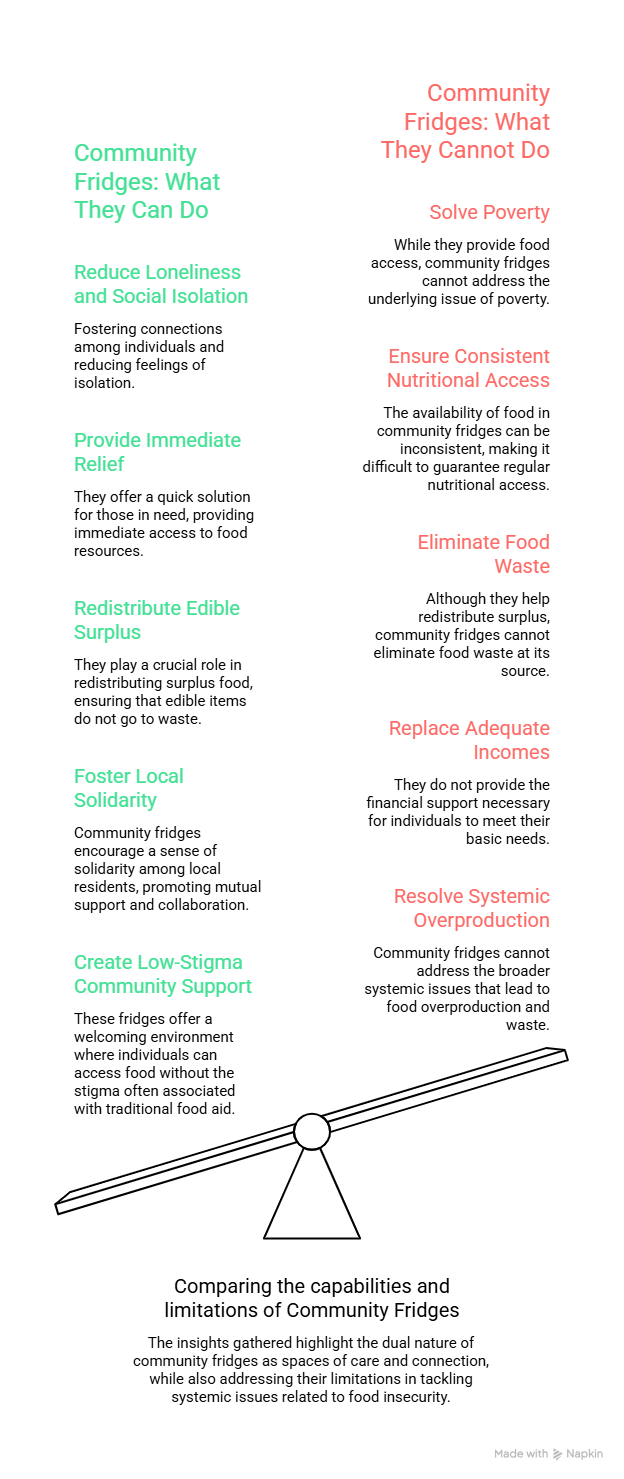
Participants consistently described the spaces as welcoming, socially mixed with low stigma. Nearly all reported feeling welcomed, while many described making friendships and feeling part of a community.
Small design choices had major impacts.
At Portobello, moving from an outdoor queueing system to an indoor café-style waiting area transformed the social atmosphere. Instead of feeling watched or exposed, people described warmth, conversation and ease. The fridge became a community anchor site rather than simply a site of aid distribution.
For some participants living with anxiety, depression or loneliness, these interactions were profoundly important. One participant explained that without the fridge they could go an entire week without seeing anyone. Another described how the space helped them “integrate into the community” after struggling socially because of autism.
Flowers distributed alongside surplus food also emerged repeatedly in participant accounts. These small gestures mattered because they communicated care beyond basic survival.
This reflects something often missed in policy discussions: food insecurity is emotional and social as well as material. Redistribution spaces can soften isolation and create belonging in ways that extend far beyond calories.
But dignity is fragile
At the same time, my research also showed that dignity within redistribution spaces is relational and unstable.
Participants described subtle moments of judgement around the amount of food taken or implied expectations around donations. Volunteering itself sometimes functioned as a way to access food more discreetly and avoid feelings of shame.
These findings complicate simplistic notions of “dignified food aid.” Dignity is not automatically created through universal access alone. It must be continually produced and reproduced through design, relationships and organisational culture.
Crucially, these systems also depend heavily on unpaid labour. Volunteers described physically demanding late-night supermarket collections, undertaken in winter conditions and sometimes perceived as unsafe.
At Greener Kirkcaldy, organisers deliberately avoided some late-night collections and refused donations dominated by high fat, sugar and salt products. While ethically important, these choices reduced the quantity of available food.
The result is a set of difficult trade-offs. Projects either absorb significant emotional, logistical and physical costs to maintain food supply or accept reduced abundance.
The limits of the “win-win”
One of the most striking findings involved the work required to sustain retailer relationships. Volunteers described routinely producing thank-you messages and photographs for supermarkets to maintain goodwill and ensure continued donations.
Here, surplus food becomes evidence of corporate social responsibility, while the structural causes of overproduction remain intact.
UK debates on food waste often focus on household waste and retail surplus, with increasing emphasis placed on redistribution as evidence of progress towards sustainability targets such as the Courtauld Commitment 2030 and UN SDG 12.3, both of which aim to halve food waste by 2030 (WRAP, 2024). In practice, this has led to the rapid expansion of redistribution infrastructures, including the Hubbub Community Fridge Network, which now includes more than 700 sites across the UK.
WRAP’s reporting increasingly frames higher levels of redistributed surplus as a positive outcome. Yet the growth of redistribution also reflects the continued expansion of surplus itself. Community fridges are growing alongside rising food insecurity and increasing supermarket surplus, revealing a deeper contradiction within the food system: redistribution depends upon the very overproduction it is intended to address.
A central issue raised throughout my research was not simply how surplus is redistributed, but why so much surplus exists in the first place. While redistribution may provide short-term value, long-term dependence on vast redistribution infrastructures risks normalising overproduction, deincentivising retailers to reduce surplus occurring in the first place, and reinforcing retailer narratives that positions excess stock as socially beneficial.
Ultimately, while consumers absorb many of the financial costs of overproduction through food prices, community redistribution networks absorb its physical excess.
Read Scarcity within Abundance: Community Fridges and the Contradictions of Food Redistribution (Part 2).