Read Scarcity within Abundance: Community Fridges and the Contradictions of Food Redistribution (Part 1).
Meals Equivalent Metrics
At a network level, community fridge success is often measured through diversion tonnage and “meals equivalent” metrics. Hubbub’s Community Fridge Network, for example, reported redistributing over 11,482 tonnes of food, framed as the equivalent of 27 million meals (Hubbub, 2025). While persuasive, these metrics focus on outputs rather than outcomes. They tell us how much surplus moves through redistribution systems, but not whether the root causes of either food waste or food insecurity are being addressed.
This reflects what researchers describe as the “prevention paradox” of redistribution: large quantities of surplus are redistributed while the systems producing overproduction and insecurity remain largely unchanged. Retail forecasting practices, overstocking, aesthetic standards and volume-based promotions continue upstream, while redistribution manages the surplus downstream.
The research also showed how these tensions materialise locally. Volunteers undertook physically demanding collections and emotionally demanding relationship-management work to keep food flowing. As I describe above, in some cases organisational commitments to nutrition, safety or volunteer wellbeing reduced the quantity of food available, revealing the constant negotiation between abundance and sufficiency within redistribution systems.
The research also showed how these tensions materialise locally. Volunteers undertook physically demanding collections and emotionally demanding relationship-management work to keep food flowing. As I describe above, in some cases organisational commitments to nutrition, safety or volunteer wellbeing reduced the quantity of food available, revealing the constant negotiation between abundance and sufficiency within redistribution systems.
Importantly, my findings suggest community fridges should not be understood as alternatives to food banks for people experiencing food insecurity, but as complementary spaces operating within a wider landscape of food support.
Participants often moved between different forms of provision depending on need, access and circumstance. What distinguished community fridges was not simply the food itself, but the forms of sociability, dignity and low-stigma access they could provide.
Taken together, the findings challenge simplistic “win-win” narratives around redistribution. Community fridges create genuine social value and meaningful everyday forms of care, but they cannot resolve the structural inequalities that drive food insecurity, nor can redistribution alone prevent food waste at source.
Redistribution is not prevention
Redistribution diverts waste after overproduction has already occurred. Prevention tackles the overproduction itself. These are not the same thing.
During fieldwork, the 2025 cyberattack affecting supermarket systems resulted in chaotic surges of surplus food entering community distribution networks. Volunteers described receiving unmanageable quantities despite their highly effective logistics. The incident exposed both the fragility and absurdity of surplus-dependent systems.
Community fridges proved adaptive and caring under pressure. But they also revealed how dependent redistribution infrastructures are on the continued existence of waste.
If food insecurity, and wider poverty reduction, policies become increasingly tied to surplus redistribution, there is a risk that hunger becomes managed through charity-linked waste streams rather than addressing the root causes through income adequacy and social security.
That is not food justice.
So, what should change?
My research does not argue against community fridges. On the contrary, participants described them as deeply valuable spaces of care, connection and mutual support.
But we need to reflect honestly about what they can and cannot do.
Community fridges can:
- reduce loneliness and social isolation
- create low-stigma community support
- redistribute edible surplus
- foster local solidarity
- provide immediate relief
They cannot:
- eliminate poverty
- ensure consistent and sufficient access to nutritional food
- eliminate food waste
- replace the need for adequate incomes and/or social welfare support
- resolve systemic overproduction
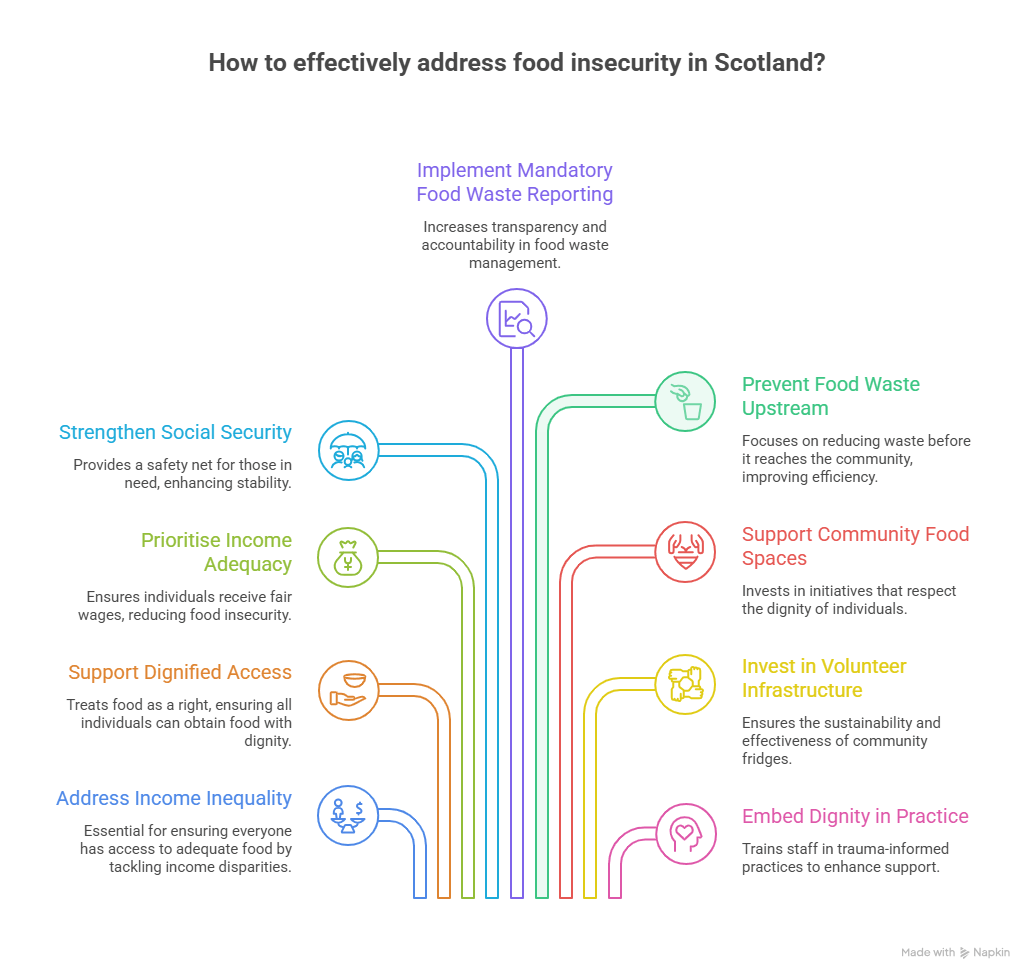
Policy therefore needs to move beyond redistribution as the central solution.
In Scotland, this also raises important questions for the ambitions of the Good Food Nation agenda. If Good Food Nation is to move beyond emergency responses and redistribution-led solutions, then addressing income inequality, preventing food waste upstream and supporting dignified access to sufficient, nutritious food must sit alongside environmental goals. The community fridges investigated in this research clearly show the social value of local food infrastructures, but they also expose the limits of relying on surplus as a long-term policy response to food insecurity.
Instead, governments should:
- prioritise income adequacy and fair work
- strengthen social security systems
- implement mandatory food waste reporting
- incentivise upstream waste prevention
- support universal and dignified community food spaces
- invest in volunteer infrastructure and safeguarding
- embed Dignity in Practice and trauma-informed training across community food projects
Importantly, community fridges should also be recognised as social infrastructures, not simply waste infrastructures. Their contribution to mental health, belonging and community resilience deserves far greater recognition within local wellbeing policy.
Looking beyond the “win-win”
The popularity of redistribution rests partly on its political appeal. It promises environmental action without challenging overproduction, and anti-poverty action without redistributing wealth.
Megan Blake’s Food Ladders framework views food insecurity as more than a shortage of food—it recognises the wider impacts of poverty on health, wellbeing, social connections and community resilience. The approach sets out three progressive “rungs”: catching people in crisis through emergency support, building capacity through food-related activities and skills, and enabling community-led change that strengthens local assets, relationships and long-term resilience.
My research found that community fridges are best understood as “mid spaces”: pragmatic local responses operating within structurally unequal food systems. As Blake’s work on Food Ladder suggests, these spaces can foster connection, participation and dignity beyond emergency food provision, creating forms of belonging and social infrastructure that matter deeply in everyday life.
Participants valued community fridges not simply for food access, but for the care, sociability and low-stigma support they offered. Yet they also recognised the contradiction at the heart of redistribution: these spaces remain dependent on surplus generated through systemic overproduction and sustained through significant community labour, much of which is unpaid.
Ultimately, hunger exists alongside abundance not because there is too little food, but because access to food remains unequal. Until policy addresses that reality, redistribution risks treating the symptoms of food insecurity while leaving its structural causes untouched.